

Structuring Your Courses with Flexible Assignment Deadlines
Practical, accountable ways to create assignment deadline flexibility that supports accessibility, equity, and academic integrity.
By Gwenna Moss Centre for Teaching and LearningWhy Flexible Deadlines Matter
University students balance diverse responsibilities and learning needs, which may include employment, caregiving, disability, health fluctuations, commuting, religious obligations, and multiple time zones. Rigid, one-size-fits-all deadlines can unintentionally create barriers that undermine learning and increase requests for individual exceptions. Structured deadline flexibility offers a transparent, equitable alternative that supports accessibility without lowering academic standards, reduces administrative burden, and maintains clear expectations for accountability.
Guiding Principles for Deadline Flexibility
Effective flexibility is designed, not improvised. The following principles help ensure fairness and consistency:
- Clarity: State deadline structures clearly in the syllabus, assignment instructions, and Learning Management System (LMS) (e.g., Canvas)
- Structure over ambiguity: Use repeatable rules rather than ad hoc decisions
- Accountability with compassion: Expect proactive communication when built-in flexibility is insufficient
- Consistency: Apply the same mechanism to all students, with accommodations layered on as needed
- Iteration: Review usage and outcomes to refine policies over time
Flexible Deadline Models with Canvas Tools
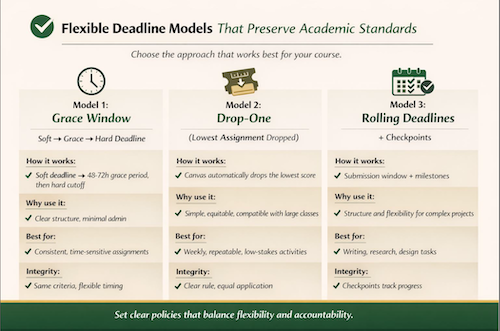 The sections below describe each model in more detail, including how it works, when it is most effective, and how it supports accessibility and academic integrity. Download this quick reference of Flexible deadline models (image right).
Grace window (soft + hard deadline)Assignments include a recommended soft deadline followed by a short grace period (typically 48–72 hours) and a firm hard deadline. |
| • Best for: Predictable assignment schedules, large classes, and assessments where feedback timing matters. • Read more: Flexible Assignment Deadlines: Grace Window Model |
Drop-one (lowest assignment dropped)Students may miss or under perform on one designated low-stakes assignment without penalty. Canvas automatically drops the lowest score. |
| • Best for: Large enrolment courses with frequent, low-stakes assessments. • Read more: Flexible Assignment Deadlines: Drop Lowest Assignment Model |
Rolling deadlines with checkpointsAssignments are completed in stages with required milestones and a final cutoff date. |
| • Best for: Research, writing, and project-based courses with complex or scaffolded work. • Read more: Flexible Assignment Deadlines: Rolling Deadlines with Checkpoints |
Choosing the Right Model
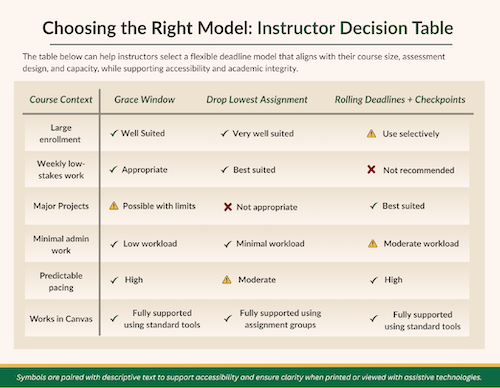 Three models have been proposed to assist with flexible deadlines and due dates, but it may be difficult to choose the right model. Once you are familiar with the models above, the information below can help you determine which approach is most appropriate for your course context, class size, and assessment design. The information in this figure is also presented in text form below to support accessibility and multiple ways of engaging with the content. Download the Choosing the Right Model decision table (shown right).
- For large enrolment courses (200+ students), both the grace window and drop-one models are well suited, with the drop-one model requiring the least ongoing instructor administration. Rolling deadlines can be used in large classes but are best limited to a small number of major assignments.
- For frequent, low-stakes assessments such as weekly quizzes or practice activities, the drop-one model is the best fit. Grace windows may also be appropriate, while rolling deadlines are not recommended for this type of work.
- For major or scaffolded projects, rolling deadlines with checkpoints are the best suited model. Grace windows may be used with clear limits, while the Drop-One model is not appropriate for high-stakes or cumulative assignments.
- In terms of instructor administrative workload, the drop-one model requires minimal ongoing effort once configured in Canvas. Grace windows involve low ongoing workload, while rolling deadlines typically require moderate instructor oversight due to checkpoint review and feedback.
- When consistent pacing and timely feedback are important, both grace windows and rolling deadlines with checkpoints provide strong support. The drop-one model offers moderate pacing support, as students may choose when to use their dropped assignment.
- Each of these models are fully supported in Canvas using standard tools:
- Grace windows through due and availability dates
- Drop-one model through assignment groups that drop the lowest score
- Rolling deadlines through structured due dates and checkpoints.
Using Flexible Deadline Models in Group Work
Flexible deadline models can be used effectively in group work. Grace windows tend to work best for group work as they create a common submission window while allowing flexibility for the group as a whole. It minimizes disruption to peer coordination and feedback cycles by reducing the need to renegotiating roles or timelines if one member experiences a temporary barrier.
Rolling deadlines with checkpoints are another option for group projects, especially if it is complex. Required milestones assists the groups in coordinating progress, distributing tasks, and addressing challenges early. Checkpoints act as reminders and moments of implementing feedback from instructors without leaving groups to manage uncertainty alone.
In contrast, drop-one (lowest assignment dropped) model is less effective for shared group work as it shifts flexibility to the individual rather than the group. However, it can still be used successfully for individual components of group work (e.g. reflections, peer evaluations, etc.) where flexibility supports individual situations without affecting the shared outcome.
Sample Syllabus Language (copy & adapt)
Flexible Deadlines and Due Dates
“To support diverse learning needs while maintaining academic standards, this course uses structured deadline flexibility. Each assignment includes a soft deadline to help you stay on track, followed by a 48-hour grace period during which you may submit without penalty or approval. A hard deadline applies after the grace period; submissions beyond this point require an approved extension.
If you anticipate needing additional time, submit the Extension Request Form before the hard deadline with a brief completion plan. No sensitive personal information is required. All work remains subject to academic integrity policies.”
Assessment Design Considerations
- Time-bound activities (e.g., exams, labs, presentations) may require stricter timing; offer equivalent alternatives where feasible
- Group work benefits from flexibility on individual components (e.g., reflections or contribution logs)
- Scaffolded assignments may allow more flexibility early, narrowing later to preserve pacing and feedback
Equity and Accessibility Notes
- Avoid requiring medical or personal documentation for built-in flexibility
- Use plain, non-judgmental language
- Communicate deadlines and windows in multiple places (syllabus, LMS, announcements)
- Clearly specify time zones for all due dates
Key Takeaway
Flexible deadlines are most effective when they are explicit, structured, and consistent. Starting with a simple model—such as a soft deadline plus a short grace period—can meaningfully reduce barriers, support student self-regulation, and preserve academic rigor. Explaining why deadlines exists – to support timely feedback, manage workload, or keep learning on track—helps students see due dates as purposeful rather than arbitrary.
Effective deadline design also recognizes that both instructors and students are human. Setting realistic deadlines and due times supports well-being and avoids unnecessary stress. For group work, flexibility works best at the shared timeline level (grace windows and checkpoints), with individual-level flexibility used for individual components where appropriate. The goal is not leniency, but equitable, manageable course design that supports learning for everyone.
For further information, check out these resources:
- Flexible Assessment Weighting: Ideas for flexible assessment design that complements deadline models
- USask Assessment Principles: Principles for effective, inclusive, and transparent assessment practices
- Class Maintenance Guide: For syllabus updates, including structuring deadlines and evaluations
- USask Academic Courses Policy on Class Delivery & Assessment: Institutional expectations regarding fair, transparent assessment
For support and guidance on designing flexible and inclusive courses connect with the Flexible Learning Team (FLT) at the Gwenna Moss Centre.
---
Article Series: See all articles related to Flexible Assignment Deadlines
- Structuring Your Courses with Flexible Assignment Deadlines (this article)
- Flexible Assignment Deadlines: Grace Window Model
- Flexible Assignment Deadlines: Drop Lowest Assignment Model
- Flexible Assignment Deadlines: Rolling Deadlines with Checkpoints
Title image credit: Serena Assie, Instructional Designer, GMCTL
This article was created with the assistance of AI tools, as described in the GMCTL AI Disclosure Statement.