

Culturally responsive teaching supports everyone. It ensures that all learners feel empowered and valued in the learning environment while simultaneously setting them up for academic success. The frameworks and principles described below illuminate how culturally responsive teaching is rooted in Indigenous ways of knowing, being, and doing and can positively impact all learners.
First Peoples Principles of Learning
The First Peoples Principles of Learning* (FPPL) were created by the BC Ministry of Education and First Nations Education Steering Committee to guide and support teaching and learning. They are described as:
"FPPL reflect Indigenous knowledges in the area of education and, as such, can be understood as a culturally responsive pedagogy for many Indigenous learners; they also provide an effective framework for teaching and learning for all learners. ... They can be described as the original inclusive approach to teaching, as they honour diversity in learners. When educators include the FPPL in the work we do, we ensure that we create access points into learning for all learners in our care." (p.119, Chrona, 2022)
|
* "Aboriginal and Indigenous are terms that include First Nations, Inuit, and Métis. These are all discrete cultural and political groups of peoples within Canada. Some people consider Aboriginal a political word imposed upon the First Nations, Métis, and Inuit of Canada, and instead prefer to use their specific identity (i.e. First Nation – or ideally, the name of the specific First Nation; Métis; or Inuit). The First Peoples Principles of Learning was named as such in order to be inclusive while not using the imposed term of Aboriginal." Learn More |
The First Peoples Principles of Learning are: (open accordions for more)
Well-being of all is the primary purpose of learning and each aspect of well-being is interconnected. Valuing each learner as an individual, while also considering how learning benefits and supports family and communities is imperative.
Learning must also connect and support the land. Respecting the previous generations who came before us and preparing for the succession of generations to come will guide how we continue to frame well-being.
Everything within education and within our world is interdependent. There is a diversity of relationships within education that enhances the learner’s experiences. These relationships require the educator to pay attention to the holistic (physical, emotional, mental, and spiritual) components of the learner.
Learning also continues to build on itself and through this relational process, it continues to evolve and make new connections. Ensuring time is given to reflect on these new connections allows learners to engage with the learning and understand what they bring into the education space. Learning is a highly social process that nurtures relationships within the family and the community. It is achieved by doing, thinking, and reflecting.
Learners need support in building an awareness that everything and everyone is connected. Furthermore, we are responsible for what happens as the result of our actions both unintended and intended, positive or negative.
Teaching and learning are the responsibility of all members of the community. Everyone has a role to play and skills to develop to support one another. Intergenerational learning continues to strengthen communities.
Indigenous knowledges are imperative to learning as they are a part of the historical and contemporary foundations of Canada; reflecting what and who is valued. Indigenous knowledges help bridge the divide and begin to eliminate endemic racism. They should be localized, when possible, to mitigate pan-Indigenous generalizations and connect to the people to Indigenous knowledges that are relevant to their experiences.
Learning reflects an awareness of the power of story and its connection to the world. Story supports our ability to connect to a memory, organize information, and organize concepts. Historical and cultural contexts in stories reflect understandings of how we came to be and who we are.
Knowledge and understanding develops in layers, with skills and competencies gained through experiences and reflections. This process requires time and patience to learn deeply, as it does not happen quickly. Learning happens when you are ready for it to occur.
Learning needs to connect with who the learner is. Exploring identity connects students to what is relevant to learn as well as to each other, to communities, and to the land. This exploration of identity creates a sense of belonging.
The Four R’s: Respect, Relevance, Reciprocity, and Responsibility
The Four R’s: Respect, Relevance, Reciprocity, and Responsibility, a framework designed by Kirkness and Barnhardt (2001) is indispensable in relation to culturally responsive teaching. When embedded into teaching and learning, the Four R’s will ensure Indigenous and non-Indigenous students experience a sense of belonging in post-secondary settings while also being engaged as learners.
Respect
For students to have a sense of belonging in learning spaces, they need to know their cultural knowledge, core values, and traditions are respected. This respect looks like not making students choose between their worldviews to engage in the learning and instead making the experience "user-friendly".
Relevance
"To the extent universities are able to reconstruct themselves to be more relevant to, and accepting of First Nations [as well as Métis and Inuit] students’ perspectives and experiences, they will be that much more relevant and responsive to the needs of all students.” (p.12, Kirkness & Barnhardt, 2001) Consider how your teaching practices and content are relevant to all learners.Reciprocity
"The emphasis is on making teaching and learning two-way processes, in which the give-and-take between faculty and students opens up new levels of understanding for everyone. Such reciprocity is achieved when the faculty member makes an effort to understand and build upon the cultural background of the students, and the students are able to gain access to the inner workings of the culture to which they are being introduced.” (p.13, Kirkness & Barnhardt, 2001)
Responsibility
It is the responsibility of educators to consider making shifts in relation to policy, procedure, and practice to ensure all students, including Indigenous students, are empowered and served in post-secondary. It is the transformation needed to ensure students feel a sense of belonging and value within the institutions.
Locating oneself
Positionality & Intersectionality
Positionality refers to the way we place ourselves within society relative to others and it is frequently influenced by a range of social and personal factors, such as:
- Race, age, religion, culture, ethnicity, language, nationality, knowledges, physical ability, gender and gender identity, sexuality/sexual orientation, socio-economic status and/or caste, education level, health (mental, physical, spiritual) – and combinations or intersections of these factors.
Engaging in reflection about the overlapping aspects of our identities aids in developing a deeper comprehension of our personal experiences, principles, and outlooks. An awareness of our social location enables us to be more conscious of the reasons behind our perspectives and values. Further, our positionality has a significant impact on how we understand and convey knowledge, course content, and perspectives.
Understanding our positionality allows us to teach with humility and intention by recognizing how our social locations shape our assumptions, interactions, course design, and decision‑making. Inclusive classrooms begin with this self‑awareness, not with strategies alone, as it is essential for teaching in ways that are responsive to learners rather than unintentionally reinforcing exclusion.
The privilege or oppression associated with overlapping identities is referred to as intersectionality. Intersectionality, a theory conceived by scholar, Kimberlé Crenshaw is the intertwining of social identities such as gender, race, ethnicity, religion, social orientation, which forms our unique experiences, opportunities, and barriers. The way consequences of various types of discrimination (like racism, sexism, and classism) merge, overlap, or intersect, can lead to multiple layers of inequities for a person or group.
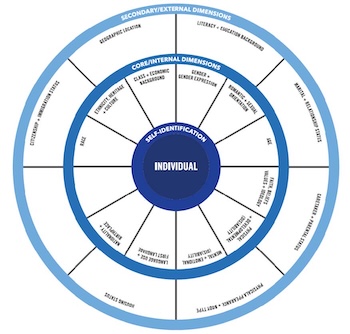 A social identity wheel can be used to explore our personal and professional identities and to bring awareness to the various positions we hold in our lives.
Pathways on the journey
Culturally responsive teaching can be achieved through a variety of interconnected pathways or strategies. While the strategies may be addressing specific areas in relation to education, the approaches and concepts often have similar themes connected to student’s well-being and sense of belonging. Within these pathways are common patterns that encourage educators to be proactive and responsive to students, which is culturally responsive teaching in practice.
Culturally responsive teaching is rooted in unpacking, addressing, and integrating decolonization, Indigenization, and reconciliation. The ohpahotân | oohpaahotaan let’s fly up together Indigenous Strategy for the University of Saskatchewan defines these as:
- Decolonization practices contest divisive and demeaning actions, policies, programming, and frameworks. Indigenization is the healing, balancing force; it calls us to action, inspires opportunities for mutual cultural understanding, and helps us to find comfort in the discomfort that decolonization can entail.
- Indigenization challenges us to amplify the forces of decolonization. Indigenization strengthens the fabric of the University. It involves the respectful, meaningful, ethical weaving of First Nations, Métis, and Inuit knowledges, lived experiences, worldviews, and stories into teaching, learning, and research. Indigenization is a gift that benefits every member of our community.
- Reconciliation is a goal that may take generations to realize. It “is about forging and maintaining respectful relationships. There are no shortcuts” (Senator Murray Sinclair, Chair of the Truth and Reconciliation Commission). As a community, we have a shared responsibility to honour and join in the journey of reconciliation; to repair, redress and heal relationships; and nurture an ethical space in which we can explore how we relate to each other through the lenses of history, culture, and lived experience.
The ohpahotân | oohpaahotaan let’s fly up together Indigenous Strategy for the University of Saskatchewan also includes seven fundamental commitments that together, guide us in creating an environment where Indigenous students feel valued and empowered to learn, which supports the learning experience for everyone. Within the seven fundamental commitments are Guiding Principles, Calls to Action, and Markers that frame supports and uplift Indigenous learners while also actualizing culturally responsive teaching. Additional resources are available on the Indigenous Education Teaching Strategy page listed below.
In higher education, equity, diversity, and inclusion (EDI) are underpinned by relational approaches to teaching and learning that recognize learners as whole people situated within communities, histories, and places; learning spaces are created where all students can access, participate in and succeed in meaningful ways.
- Equity involves addressing systemic barriers by honouring different ways of knowing, being, and doing, and by responding to learners’ distinct contexts and responsibilities.
- Diversity acknowledges the richness of multiple identities, knowledges, and worldviews, including Indigenous knowledges that have historically been marginalized within post‑secondary institutions.
- Inclusion emphasizes the creation of learning environments rooted in respect, relevance, reciprocity, and responsibility, where learners experience belonging and are not required to set aside who they are in order to succeed.
The EDI Flower illustrates how these principles are enacted through interconnected teaching practices such as dialogue, relational environments, inclusive content, flexible assessment, and educator positionality. Together, EDI in teaching reflects an Indigenous‑informed commitment to learning that is holistic, relational, and accountable to the well‑being of learners, communities, and future generations, with pedagogical approaches which are responsive and relational.
- Provide multiple means of engagement
- Provide multiple means of representation
- Provide multiple means of action and expression
When we integrate these principles, UDL removes barriers to learning and supports the success of all students.
Accessibility is another pillar of culturally responsive teaching. As the Accessibility Guidelines state:
“Accessibility means designing learning materials, courses, and experiences so that all students can participate fully and equitably.”
In other words, accessibility is a critical step that encourages educators to be mindful when developing their pedagogies and content to proactively create learning environments where all students can achieve success.
Another opportunity to enact culturally responsive teaching in practice is through the lens of sustainability.
Sustainability in action requires “engaging in social, environmental, and economic development that meets the needs of the present while mindfully and respectfully protecting the ability of future generations to meet their own needs.”
To be clear, sustainability enables learners to develop the skills they need to build a sustainable future for themselves and the world.
EDI and Indigenization
Indigenization, Decolonization, and Reconciliation and EDI are distinct but interconnected initiatives, each contributing in different ways to more just and responsive learning environments.
Decolonization and Indigenization are tied to the histories and interactions between First Peoples and settlers. Indigenous Peoples have unique and distinctive rights in Canada as recognized in Section 35 of The Constitution Act, 1982. The fight for sovereignty and self-governance on ancestral Indigenous lands and the fight against systemic racism and assimilation is different than the battles of marginalized groups for equity and inclusion.
In contrast, EDI aims to promote equity, diversity, and inclusion, centering the interests of marginalized groups to ensure fairness and a sense of belonging, rather than encouraging everyone to ascribe to the same norms. (adapted from Universal Design for Learning: One Small Step)
Resources
See these resources and articles to further explore this topic.
References
Arcand, E., Arcand, L., Badger, B., Battiste, M., Blair-Dreaver Johnston, A., Buffalo, M., Campbell, M., Creely-Johns, M., Cummings, N., Duquette, R., Fleury, N., Halfe, L., Hamilton, M., Henderson, M., Kayseas, F., Kayseas, E., Keewatin, M., Lewis, K., Linklater, L. J., … Tsannie-Burseth, R. (2021). ohpahotân | oohpaahotaan. University of Saskatchewan. https://indigenous.usask.ca/documents/lets-fly-up-together.pdf
Chrona, J. (2022). Wayi Wah! Indigenous pedagogies: An act for reconciliation and anti-racist education. (First ed.). Portage & Main Press.
Kirkness, V. J., & Barnhardt, R. (1991). First Nations and higher education: The four R's—respect, relevance, reciprocity, responsibility. Journal of American Indian Education, 1-15.
Kovach, M. (2021). Indigenous methodologies: Characteristics, conversations, and contexts (Second ed.). University of Toronto Press.
Get support
For support or a consultation on this topic, reach out to the team at the Gwenna Moss Centre for Teaching and Learning.
Related teaching articles
Loading...