

Teaching Portfolios
A teaching portfolio is a carefully curated collection of materials that communicates your identity, values, and impact as an educator.
By Gwenna Moss Centre for Teaching and LearningMore than just a set of documents, a strong portfolio (or teaching dossier) presents a coherent narrative that connects your teaching philosophy, practices, and evidence of effectiveness into a persuasive account of your teaching development.
Why Create a Teaching Portfolio?
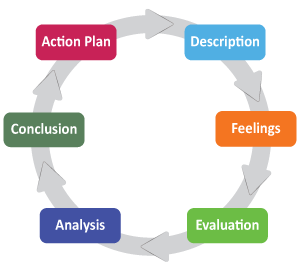
A teaching portfolio brings together the many purposes of teaching in higher education into a single, coherent narrative. It provides a structured way to document and communicate teaching effectiveness for hiring, promotion, and awards, while also supporting ongoing reflection and professional growth.
In developing a portfolio, educators articulate their teaching philosophy, align it with their practices and evidence, and make visible the broader dimensions of their work – such as mentoring, educational leadership, and commitments to EDI, accessibility and Indigenization. The process encourages a scholarly approach to teaching, where decisions are intentional, evidence-informed, and responsive to feedback. *Image above illustrates Gibb's Reflective Cycle1
As both a reflective tool and an outward-facing document, the portfolio supports educators in understanding, improving, and effectively communicating teaching growth over time.
Teaching Philosophy Statement
At the heart of every portfolio is a teaching philosophy statement, typically a concise (1-2 page, single-spaced) reflective narrative which articulates your beliefs about teaching and learning, your goals for students, and how these are enacted in your practice. Convincing statements explicitly align your beliefs with practice by demonstrating how your values shape course design, teaching strategies, and assessment approaches.
The reader should be able to ‘hear’ your voice throughout the statement, and it should set you apart from others who are at similar places on their teaching development journey. For example, a commitment to active learning should be reflected in the use of collaborative activities, case-based learning, or discussion-based classes. Effective philosophy statements move beyond description to explain why you teach as you do and are supported with concrete examples and evidence.
Portfolio Structure
While formats vary across disciplines and purposes, portfolios in Canadian universities often include:
- teaching philosophy statement,
- teaching responsibilities and experiences,
- teaching practices and innovations,
- evidence of effectiveness,
- reflection and future goals, and
- throughout, a consideration of the Learning Charter of your university
This structure supports an integrated argument demonstrating alignment between your beliefs, actions, and outcomes. Reflective comments are often woven throughout the document, establishing you as a reflective practitioner.
Mentoring and Educational Leadership
Teaching portfolios can highlight contributions beyond the classroom, including mentorship of undergraduate and graduate students, supervision of research, and participation in curriculum development or pedagogical leadership. These activities demonstrate your broader role in supporting student learning and advancing academic communities.
Equity, Diversity, Inclusion (EDI), Accessibility, and Indigenization
Increasingly, educators are expected to demonstrate how their teaching fosters inclusive, equitable, and accessible learning environments and references the University’s frameworks and guidelines for EDI and accessibility.
This section of your portfolio may include applying Universal Design for Learning Principles, integrating diverse perspectives, and engaging in Indigenization through respectful inclusion of Indigenous knowledges, pedagogies, and relationships. Reflecting on your positionality and its influence on your teaching is an important part of this work.
Evidence of Teaching EffectivenessCompelling portfolios include carefully selected evidence to support your claims about teaching. Examples of evidence types include:
- student feedback (e.g., course evaluations, midterm feedback)
- peer observations or reviews of teaching
- sample course materials (syllabi, assignments, assessments)
- examples of student work (with permission)
- evidence of student learning (grade distributions, achievement of outcomes)
- teaching awards or nominations
- participation in professional development or teaching workshops
The goal is not quantity, but relevance. Evidence should clearly illustrate your teaching impact, growth, and responsiveness to feedback.
----
Resources and Guides
- USask Renewal, Tenure and Promotion and refer to your college and/or department standards
- Teaching Philosophies & Teaching Dossiers Guide - University of Calgary
- Preparing a Teaching Portfolio Guidebook - McMaster University
- Teaching Portfolios - University of British Columbia
- Teaching Dossier Resources - Queen’s University
- Teaching Portfolio Preparation - McGill University
- 1 Learning by Doing, A Guide to Teaching and Learning Methods, G.Gibbs, 1988
Get support to build your teaching skills:
For grad students and post-docs see the Teaching Preparation Certificate
New faculty, sessional lecturers, lab instructors see the Certificate in University Teaching and Learning
Title image credit: website/author
This article was created with the assistance of AI tools, as described in the GMCTL AI Disclosure Statement.