

USask Sustainability Fellowship Profile: Norman Sheehan
Sustainability in business - Dr. Norman Sheehan, Professor, Department of Accounting
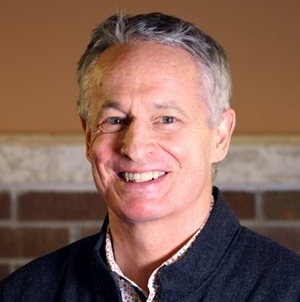
Leading Change in Teaching at Edwards School of Business: Norman Sheehan’s Fellowship Journey
As a Sustainability Faculty Fellow, Dr. Norman Sheehan’s work has focused on embedding sustainability more deeply into the undergraduate curriculum at the Edwards School of Business.
For Norman Sheehan, sustainability wasn’t always part of the conversation. Before entering academia, Sheehan worked as a CPA for mining and oil and gas companies in Canada and internationally.
“At that point, there weren’t many environmental concerns in the way we think about them now,” he reflected. Even after transitioning into academia and earning his PhD in strategy in 2001, sustainability remained largely absent from his teaching and research. That changed in 2008, when a conference session on the Principles for Responsible Management Education (PRME) prompted a shift.
“I remember thinking, I really have to do something. I came back and started integrating sustainability into my strategy classes,” he said. At the time, students noticed. Sheehan recalled, “They would come up and say, ‘We’re so happy you’re teaching this. No one else is talking about it’.”
Since then, Sheehan has become a long-standing advocate for embedding sustainability into business education through teaching, research, and curriculum development.
Building sustainability into business education
As a Sustainability Faculty Fellow, Sheehan’s work has focused on embedding sustainability more deeply into the undergraduate curriculum at the Edwards School of Business. Building on earlier efforts to incorporate sustainability into the school’s mission and vision, Sheehan worked with Edwards’ curriculum renewal team to map out sustainability competencies across all Edwards’ core courses.
“If you want students to learn about sustainability, it has to show up in the competency map,” he explained. “If it’s there, it gets assessed. And if it gets assessed, we have to teach it.”
This system-level approach reflects his accounting background, where measurement and accountability are central. “If you can’t measure it, you can’t manage it,” he said. “That’s where accounting plays a huge role in enhancing corporate sustainability - tracking performance, ensuring transparency, and helping organizations be held accountable.”
Over the years, Sheehan’s experience has informed his teaching practice, and his ability to strategically engage students to develop sustainability competencies.
Teaching sustainability in a polarized classroom
While sustainability has become more visible across classes at Edwards, Sheehan notes a growing challenge: increasing polarization among students.
“In the past, most students were somewhere in the middle,” he explained. “Now, many come in with strongly held views at one end of the sustainability spectrum, often shaped by social media, and they’re less open to engaging with sustainability.”
To address this, Sheehan developed an in-class learning activity designed to foster dialogue across differences. Students are asked to take a position on a sustainability issue, discuss it with a peer, and then paraphrase the other person’s perspective.
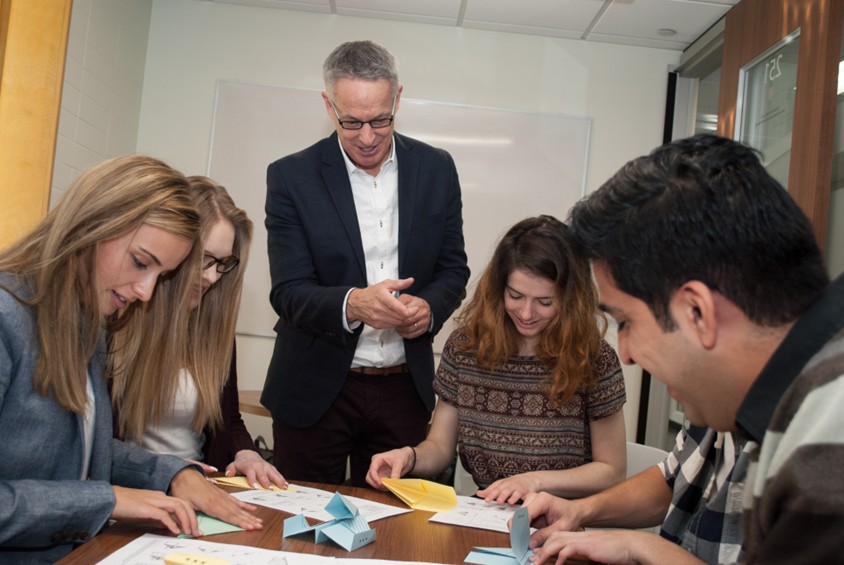 “The goal isn’t to change minds, it’s to help students hear each other,” he emphasized. What he observed was powerful. “There was something happening in the classroom. Students were really engaged,” he recalled. “When people feel heard, they’re more open to hearing others.”
Beyond critical thinking, the exercise also created unexpected moments of connection. “Students were talking to people they wouldn’t normally talk to,” he said. “That matters, especially when students have become more isolated post-Covid.” This activity, designed to help students engage with sustainability learning, also contributed to a more sustainable classroom and experience by promoting student wellbeing.
Shifting perspectives on the purpose of business
One of the most impactful moments in Sheehan’s current teaching plan comes later in the term, when he challenges a widely help assumption: that the purpose of a corporation is to maximize profit.
Sheehan explained, “Most students come in believing that, but under Canadian law (CBCA), the purpose is actually long-term sustainability—ensuring the organization remains viable while considering stakeholders.” This reframing opens the door to deeper conversations about sustainability.
“You can’t just focus on profit,” he said. “You also have to consider employees, communities, and the environment. That’s what long-term organizational success actually depends on.” For many students, this realization is a turning point. “It surprises them every year,” he said. “But it also helps them see why sustainability matters in business.”
Learning through community
As a Sustainability Faculty Fellow, Sheehan highlights the value of connection and collaboration.
“The best part of being a fellow was the people,” he said. The Sustainability Faculty Fellowship program brings educators together, each from a different college or school. “Meeting others across campus who are working on sustainability in different ways - engineering, geography, biology - was incredibly valuable.”
These interdisciplinary conversations not only broadened his perspective but also reinforced a shared sense of purpose. “We’re all working toward the same goal, just from different angles,” he said.
The fellowship also provided Sheehan space for personal and professional growth. He acknowledged that sustainability work in the classroom can be complex. “You have to navigate different perspectives and create space for respectful dialogue,” he said, “but that’s also what makes it important.”
Working with other instructors can help to navigate these complexities. “It helped me reflect on my own teaching and think about new approaches,” he noted “I’m grateful to be part of that community.”
Sheehan offered words of encouragement to those considering applying for future fellowship opportunities. “You receive a lot of support, and you’ll connect with people who care deeply about this work,” he said. “It’s a chance to grow, to learn from others, and to contribute in a meaningful way.”
Looking ahead
Despite current local and global challenges, including shifting geopolitical and economic contexts, Sheehan remains optimistic. “It can feel like we’re losing ground,” he remarked. “But if you look over time, there is progress.”
For him, the work continues in small but meaningful ways: embedding sustainability into curriculum, fostering dialogue in the classroom, and helping students develop the skills to navigate complex issues.
“Even just helping students hear more than one side,” he said, “that’s a step forward.”
---
Dr. Sheehan's fellowship work directly supports the Sustainability Strategy, particularly Commitment 3: Empower Action. For more information on the strategy, please visit the Office of Sustainability’s website.
Visit our page to learn more about the Sustainability Faculty Fellowship, or email Gwenna Moss Centre for Teaching and Learning.
Title image credit: Joey Kyber | Pexels.com
This article was created with the assistance of AI tools, as described in the GMCTL AI Disclosure Statement.