

USask Sustainability Fellowship Profile: Reisha Peters
Sustainability in engineering - Dr. Reisha Peters, Assistant Professor, Chemical and Biological Engineering

Shifting perspectives in engineering: Reisha Peter’s Fellowship Journey
Integrating sustainability into teaching can be challenging for a variety of reasons, but Dr. Reisha Peters demonstrates how small shifts in perspective and course design can create lasting impact for students.
Her experience offers a compelling look at how faculty can embed the SDGs meaningfully, even in content heavy programs.
For many university instructors, integrating sustainability into their courses can feel complex or even out of reach. Sustainability appears to be a standalone concept, disconnected from their research, teaching, or day-to-day responsibilities. Reisha Peters, assistant professor in the Department of Chemical and Biological Engineering and a Sustainability Faculty Fellow, is demonstrating that this connection becomes more accessible with social and logistical support.
Redefining sustainability
Peters joined the 2024–26 Sustainability Faculty Fellows cohort shortly after accepting a faculty position at the University of Saskatchewan in January 2024. Although sustainability had always aligned with her personal values, it was the SDG Multiplier Training offered through the Gwenna Moss Centre for Teaching and Learning that broadened her perspective on how to embed sustainability into her teaching.
“(Before taking the course) if I made a word cloud about sustainability, it would have been a lot of ‘environment’ and ‘green,’” she said. She notes that this narrow view overlooks the social, economic, and equity-focused dimensions of sustainability.
Through the training session and her introduction to the United Nations Sustainable Development Goals (SDGs), Peters began to see sustainability as a multidimensional concept. When she brought these ideas into her classroom, she found that students from all backgrounds could see themselves reflected in the SDGs. As she put it, “No one could fight that they each had a place somewhere in sustainability.”
Integrating sustainability into teaching
While Reisha knew that the Sustainability Faculty Fellowship’s directives aligned closely with her personal beliefs and goals as an educator, she also found herself in a particularly advantageous position. Preparing to teach Introduction to Process Engineering (CHE 220) for the first time, Peters recognized a chance to redesign the course with sustainability at its core.
“This was an amazing opportunity for me to embed design and sustainability side by side,” she said. “We could do this as a holistic approach in the entire course.”
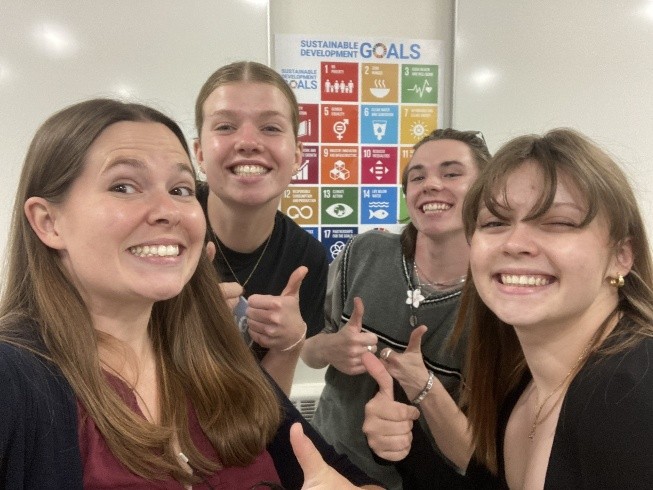
She ultimately rebranded the course around a sustainability focused design project, developing 13 project options over the summer. One student group, for example, designed a process aimed at increasing the number of women in engineering, directly engaging with SDG 5: Gender Equality. Projects like this helped students understand sustainability as more than environmental stewardship, but deeply connected to equity, inclusion, and systems design.
As the term progressed, Peters noticed a shift in how students engaged with sustainability concepts. “We would have a sustainability moment at the beginning of most classes,” she said. She intentionally kept sustainability at the forefront of daily learning with the hope that students would come to recognize it as a significant consideration in their projects that could transfer into their role as engineers. She noted that as time went on, students started making their own connections and pointing out these examples of sustainability more on their own.
Navigating challenges
Engineering courses have not traditionally explicitly emphasized sustainability, particularly those courses that are long established and content heavy. Peters acknowledges that adding new material can feel daunting. However, she has found that sustainability concepts are often already present in coursework; they simply have not been defined or identified as such.
Despite these challenges, she sees meaningful progress. Newer courses, particularly in first-year engineering, have been fully revamped, weaving sustainability throughout. The College of Engineering has also shown strong support for embedding the SDGs into curricula more intentionally. Peters emphasizes that early exposure matters. When students encounter sustainability in their first or second year, they carry that awareness into advanced courses.
The impact is already evident. Peters has taught some of the same students again in subsequent classes and has seen them make connections back to the sustainability concepts that they encountered in her first-year course. One former student, who had just begun his career, recently told her that many companies use the SDGs to guide their values and planning. When asked about sustainability in job interviews, he felt confident and well prepared, crediting his coursework with helping him secure multiple job offers.
Building community beyond the classroom
For Peters, one of the most meaningful aspects of the Sustainability Faculty Fellowship has been the sense of community it fosters. “It feels like I had a much better support system than I would have otherwise,” she said. Connecting with her cohort and overlapping fellowship groups allowed her to build new relationships and strengthen existing ones across disciplines.
The fellowship has also exposed her to a wide range of teaching approaches and methods. Seeing how other faculty members engage students in sustainability has reinforced her belief that sustainability is not a single method or message. Rather, it is a flexible, interdisciplinary lens that can be integrated through curricula across the university.
Through her fellowship and her teaching, Peters is helping reshape how engineering students at USask understand sustainability; not as an isolated topic, but as a foundational perspective that informs design, decision-making, and professional responsibility.
Peters’ fellowship work directly supports the Sustainability Strategy, particularly Commitment 3: Empower Action. For more information on the Strategy, please visit the Office of Sustainability’s website.
Visit our page to learn more about the Sustainability Faculty Fellowship, or email Gwenna Moss Centre for Teaching and Learning.
Title image credit: Joey Kyber | Pexels.com
This article was created with the assistance of AI tools, as described in the GMCTL AI Disclosure Statement.