

Determining Levels of Acceptable GenAI Use
Deciding what level of GenAI use to permit is only half the job. Students also need clear explanations of what kinds of help are allowed, and why.
By Gwenna Moss Centre for Teaching and LearningAs reported in the Digital Education Council’s global study of AI in higher education in which USask participated, students are divided on their AI use. Many are more cautious about GenAI than we might assume. Some have not used it at all. The ones who do want to use it well are not confident we can guide them, and few say their instructors make clear when AI can be used on an assessment. One thing remains true for almost all of our students: they agree that leaning too much on AI will hollow out their learning.
Those findings point to a shared problem: our students do not know where they stand. Deciding what level of GenAI use is acceptable is the first half of the work, and talking with them about that decision is the half we too easily skip.
Start with the syllabus, then keep talking
Expectations belong in the syllabus and alongside each assessment’s instructions, since what we permit defines unpermitted assistance in our courses. The USask academic integrity guidance on GenAI offers sample statements to adapt.
Writing them down is the easy part. Our student guidelines for AI use ask students to seek clarification early and often, and to prioritize dialogue with instructors and peers over dialogue with a chatbot. A student asking whether they can use GenAI is doing exactly what the university asked of them.
Describe the kind of help, not the tool
Tool names go stale quickly. The kinds of help our students look for do not. In previous years, USask, like many institutions, pointed to the AI Assessment Scale (Furze, 2023) as a useful starting point for determining levels of acceptable AI use. That scale has continued to evolve, and it remains recognizable to many educators. At USask, educators and colleges have also developed approaches that describe GenAI use in ways that fit their teaching contexts. One example is the KIN GenAI Framework from the USask College of Kinesiology. The framework sorts GenAI use into roles students recognize, from tutor and practice provider through editor and co-writer, and beside each one names the human equivalent: asking an instructor a question, practising with a peer, following a template, co-authoring a group report.
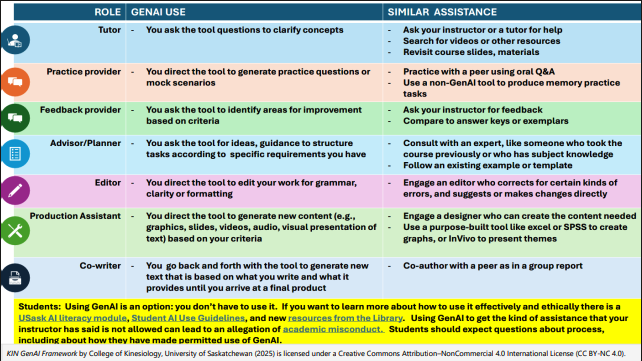
Click to view larger (PDF)
Our students already know whether asking a friend to proofread a draft is fair play, so describing GenAI that way gives them something to reason with. Connect with gmctl@usask.ca to discuss using or adapting this framework in your course or program.
Set a level for each assessment
The roles turn practical one assessment at a time. Which kinds of assistance still leave us assessing what we meant to assess? On a literature review we might welcome the tutor and advisor while ruling out the co-writer. On a reflective piece the editor may be fine and anything that generates content is not.
Most of the useful ground sits in the middle. Letting students generate ideas, plan an approach, or tidy a final draft mirrors help we have always allowed from peers and tutors, and leaves the thinking we are grading in their hands.
Both ends cost more. A prohibition is clear but expensive to hold up: monitoring, often invigilation with its accommodations and staffing, and no detection tool behind it. Open use needs acknowledgement. The Library’s guide to citing GenAI and our article on being transparent with AI use cover the formats.
Give the reason out loud
Rationale is the part we leave out and the part our students remember. "I want to see what you can do on your own here, because your field will expect you to do it without help" lands differently than "no AI," and it makes the restriction about their learning rather than our convenience.
It also starts a better conversation. Hearing why a task is off limits, students often volunteer how they had planned to use GenAI, which is worth knowing.
Why detection is not the answer
Detection tools are unreliable, a false accusation can follow a student for years, and no detection tool is approved for use at USask. Asking about process works better. A short reflection, a question in our feedback, or a couple of minutes on a draft tells us more than any tool, and our students have been told to expect the question.
Where to point students
Approved tools change, so point to the list. The LTE Toolkit sorts approved learning technologies by function, and the AI Tools at USask page in PAWS shows what is available now, including what is free for students, with privacy protections consumer tools lack. For our own footing, start with the AI literacy resources for educators, the Faculty AI Literacy Framework, and Artificial Intelligence at USask. The Library’s guidelines for using GenAI are worth sharing with students.
Our students will meet GenAI in their fields whether or not it appears in our courses. Deciding what we will permit is most of the thinking. Telling them about it is most of the teaching.
Title image credit: Noelle Otto on Pexels
Updated Sept 2026. This article was created with the assistance of AI tools, as described in the GMCTL AI Disclosure Statement.